
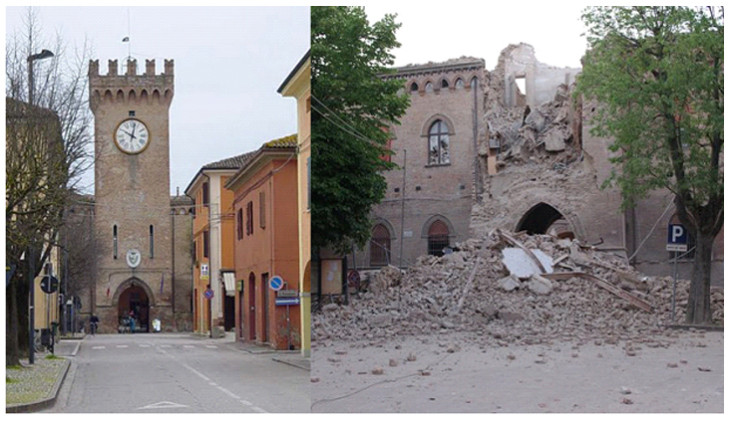
L’evento sismico dell’Emilia Romagna (2012)
ICOMOS Italia-Working Group on Emilia Romagna seismic event
At 04:03:52 Italian time, a strong earthquake lasting twenty seconds of seismic moment magnitude equal to 5.9, preceded a few hours earlier (at exactly 01:13 and 01:42) by two aftershocks of 4.1 MI (Mw 3.98) and 2.2, was felt throughout northern and part of central Italy, awaken by the majority of people, with its epicenter in Finale Emilia with 6.3 km depth. The earthquake has mainly affected the provinces of Modena, Ferrara, Mantua, Reggio Emilia, Bologna and Rovigo.
The quake caused 7 confirmed dead, 50 injured, 5,000 displaced persons, and substantial damage to cultural heritage due to the collapse of many historic buildings, farms and factories.
The earthquakes of 20 May and 29 May caused heavy damage to rural and industrial buildings, water canals, as well as to buildings and historical monuments and old civil construction in stone or pebbles. In particular were seriously damaged or partially collapsed most of the monuments and places of artistic interest in a wide area, from Mantova to Modena to Ferrara to some municipalities in the province of Bologna, whose respective provinces were found to be the most severely affected and damaged by the earthquake. In some cases were also damaged residential buildings of recent construction; such damages are often attributed to the widespread phenomenon of liquefaction of sands.
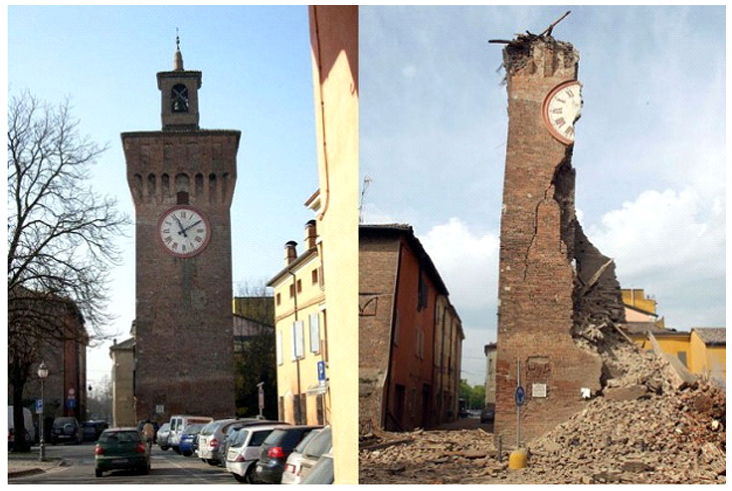
Torre dell’Orologio – Finale Emilia
(www.equilibriarte.net)
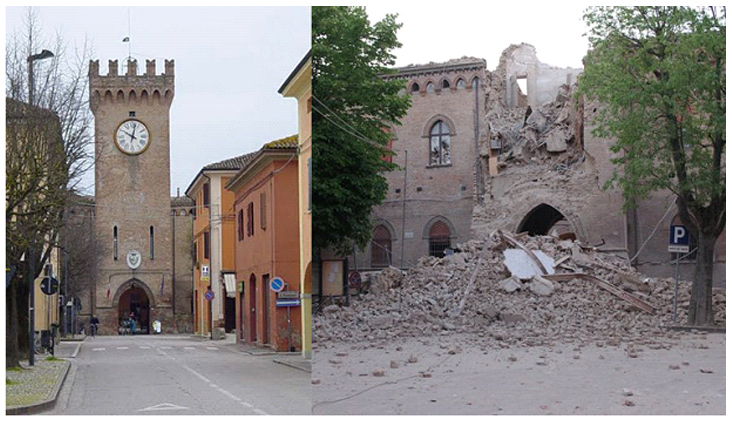
Torre dell’Orologio di Castello Lambertini-Poggio Renatico
(www.equilibriarte.net)
ICOMOS Italy, in response to the event, set up with Scientific Committees ICORP and ISCARSAH a working group which drafted the following document:
Prof. Ing. Giorgio Croci – Working group President
Ing. Arch. Maurizio Di Stefano – ICOMOS Italiana President and working group Coordinator
Prof. Ing. Alessandro Baratta
Arch. Carlo Cesari
Prof. Sergio Lagomarsino
Arch. Pietro Laureano
Ing. Luciano Marchetti
Prof. Ing. Luigi Petti
The seismic event that struck the low part of oriental Po valley with two main tremors on May 20th and 29th, 2012, with a magnitude between 5.8 and 6.0 on the Richter scale, damaged, in a significant way and on an extensive area, historical monuments, houses and industrial sites, deeply devastating the geomorphology of wide areas with consequences on soil conditions, surface and ground water and erosion phenomena.
The area in which are included the provinces of Ferrara, Modena and Mantua and partially Bologna, Reggio Emilia and Rovigo was deeply hurt and devastated in its essence made of identity, social and economic relationships, organized in urban, productive and rural areas, where monumental and landscape heritage values are strongly related to each other.
The damages of the constructions and the doubtfulness of the risk conditions as for the specific crack patterns determine a serious unease. In this emergency situation, in which the static configuration of buildings is generally compromised by the main event and is subject to steadily worsening due to after-shocks, the experts called to give technical answers have to take a great personal responsibility with the possibility of both caution excess, which extends time and doubts, and hasty decisions of demolitions. The risk that companies can propose solutions not comparable neither at a technical level nor at cost levels is high, making also possible speculation.
Due to the uncertainty of times and procedures, those who have the financial resources and who want to quickly return to normality could realize fast new houses or industrial sites, notwithstanding the current regulations, with the effect of indiscriminate increase of space wasting, introduction of building typologies unfamiliar to the territory, removing the chance to recover the original heritage and landscape.
In the areas hit by the event there are three World Heritage Sites on which it is necessary to pay the maximum attention:
- WHS Cathedral, torre Civica and Piazza Grande MODENA;
- WHS FERRARA, City of the Renaissance, and its PO Delta;
- WHS MANTUA and SABBIONETA.
The universal and extraordinary values of the above-mentioned sites are strictly related to the ones of the landscape, of the urban and rural areas, and of the traditions which make those sites World Heritage.
As a consequence, it should be necessary to define areas in which joint measures might be taken, aiming at improving both single properties and historical urban centres, thus preserving the landscape as a whole.
In this context, ICOMOS Italiana, as advisory body of the World Heritage Committee – UNESCO, aims at promoting initiatives to preserve landscape by monitoring the current situation, and giving a guide and monitoring the actions on cultural heritage.
ICOMOS Italiana underlines that measures have to ensure responses to immediate needs of a common agreement that does not affect the identity of places and the integrity of the architectural heritage and landscape. Recovery and reuse of the structures must be guaranteed by mean of a multifaceted strategy that allows rapid interventions and long-term actions. This strategy must focus on primary consideration of tangible and intangible value of the environment and the landscape as a whole, without defining hierarchies of value between the different components: cultural heritage, houses, production, facilities, territory.
The methods of reconstruction should provide an opportunity to introduce maintenance practices and land management oriented to the reduction of consumption of non-renewable resources starting from the ground, the awareness of the environmental factors fragility, risk prevention, adaptation to climate change, conservative management of forestry assets. The earthquake emergency becomes the opportunity to affirm the territory as a model of “best practice” of sustainability and proactive response to the risks and disasters operating for this purpose to:
- Restore in urban areas a tissue that identifies the characteristics, the quality of spaces and the living conditions using the resources in the most efficient way;
- Combine agricultural production in rural areas with the qualitative and quantitative management of water resources and maintenance of the systems of artificial water drainage and reclamation;
- Promote innovative forms of recycling and re-use of traditional techniques and local materials in construction practice;
- Encourage the participation of the population and, in particular, of the weak segments, enhancing the system of local self-government and their aggregate forms in the decision-making management;
- Operate with a view to planning policies on the entire Cispadano district for resource planning and infrastructure.
In that area ICOMOS Italia recognizes and underlines the following main initiatives:
Prevention: “Priority chart”
The philosophy of prevention is one of the main discussed issue after each earthquake and then, often, forgotten. In 1990 in Assisi there was a conference on the prevention and preservation of cultural heritage, in which there were made several practical proposals which had not been followed up. In 1998, after the partial collapse of the basilica, an international conference was organized with the aim to develop a “risk chart”.
Several initiatives could be found nowadays but a risk chart seems so far with regard to the intrinsic value of each good, by considering its significance in urban and landscape context, costs, etc..
The exact knowledge of the situation in the territories stricken by the event is a necessary condition to define policies and guidelines to develop safety and preservation measures for the cultural heritage.
ICOMOS Italiana would like to develop initiatives finalized to the collection of the available information and data on the cultural heritage present in the areas hit by the seismic event in order to have an online database. This will be the first step to define the priority chart.
Historical centres and built-up areas: implementation of safety measures
Attention should be given to town centres and small built-up areas whose value consist not in the individual element but in the context in which they are. A massive intervention of propping and consequently a prolonged closure of activities cause an increase in degradation and future costs and destroy the social fabric which represents the true value of an historical centre: this is unfortunately what is happening in L’Aquila.
Of remarkable importance is the concept that the value of a cultural good is inseparable from the possibility of enjoyment of the same. Therefore, the protective measures, although put in place in emergency, should be designed to be used in a short-term period, or, alternatively, be incorporated to program the availability of the good. This awareness points towards strictly necessary safeguarding measures, taking into account the financial shortfalls that arise anyway during events that affect seismic areas characterized by high levels of vulnerability. These measures can provide temporary safety relief that ensures feasibility for limited periods waiting for further definitive interventions.
The reconstruction can only be preceded by an historical, environmental and urban planning study that dictates strict rules for the redevelopment of the area and the preservation of its values. These rules may also represent a filter for the elimination of incongruous structures. It is necessary a rational reconstruction, avoiding bad and simplistic repetition of built-up areas.
Temporary feasibility
Feasibility is one of the most important problems that arise immediately after an earthquake. The procedure for issuing a certificate of occupancy, however, can be delayed, particularly in the case of cultural heritage, by several factors, including the time required for a complete understanding of the situation of instability and accountability that becomes sometimes very heavy. All of this can lead to excessive caution.
It should be noted, therefore, the importance of the “Temporary Feasibility” criterion which would allow a time-limited use, including temporary and/or partial interventions and periodic check on structures to verify and monitor the evolution of the conditions of feasibility awaiting of more massive and expensive work. The explicit regulation of this criterion, clarifying responsibilities and legal aspects, would allow the technician to act notwithstanding the most restrictive laws, avoiding excessive precautions that could have a profound impact on the cost and recovery of activities.
Temporary measures, Partial measures
Of particular relevance is the definition of safety and performance levels that can/should be pursued in the implementation of seismic improvement interventions on cultural heritage. The choices of action may involve, in fact, both a distortion of the property on which they operate and a burden of responsibilities and role of the designer. It is also recognized that temporary measures, or part of them, may be considered as a first step towards the establishment of a comprehensive project of repair and/or consolidation in which “Partial measure” criterion has a substantial role.
It should be noted, therefore, the importance of the “Temporary Feasibility” criterion which would allow a time-limited use, including temporary and/or partial interventions and periodic check on structures to verify and monitor the evolution of the conditions of feasibility awaiting of more massive and expensive work. The explicit regulation of this criterion, clarifying responsibilities and legal aspects, would allow the technician to act notwithstanding the most restrictive laws, avoiding excessive precautions that could have a profound impact on the cost and recovery of activities.
It is of utmost importance to explicitly include temporary improvement measures in guidelines and standards, clearly defining specific performance levels.
As far as the emergency management is concerned, the necessity to preserve the integrity of the cultural heritage, in the context of a correct restoration approach, requires the necessity of applying interventions of extreme urgency “compatible” and “reversible”. Chaining, for example, can be in many cases an active solution for final consolidation purposes with the advantage of allowing an immediate use with less bulk and obstruction, compared to widespread propping.
Subsequently, the final restoration will be guided by the binding rules for interventions on masonry buildings respectful of their nature and disregarding the ineffective reinforcements, for example, with rigid structures in reinforced concrete, which have shown in many cases their dangerousness encouraging or causing collapse.
It should be emphasized that a reasonable reconstruction requires longer times in order to meet two fundamental requirements:
- Preserve the existing structures such as track and witness for the reconstruction, preserving their static and defending them from predictable deterioration due to weathering;
- Create the conditions for cultural heritage temporary use, so that population continues to feel they belong to part of the city.
The technical and administrative procedures should be coded as far as possible, avoiding starting to lay down rules for the reconstruction at every catastrophic event without taking into account the positive experiences of past events. In the case of L’Aquila, for example, three years after the earthquake, notwithstanding the reopening of some parts of the old town, there are still no defined administrative rules and technical advice that allow individuals to take action for the reconstruction of their homes.
Public-private participation
Past and recent experiences show a general unsustainability of policies aimed at the preservation of cultural heritage. These policies are based only or mainly on public support. This is even more dramatically evident the greater the cultural heritage of a country, especially with Italy.
A solution lies in the possibility to activate new management procedures which see the sharing of private as an active part and not just with promotional intent. In this context, the “Loan” is an administrative way for individual assets as part of a territorial policy of management promoted by public and private actors.