
Memories of stone in the streets of the water: The Valley of the Mills in Gragnano
The Valley of Gragnano is one of the pearls of the Monti Lattari park both for its beautiful natural Mills (flora, fauna, water system, microclimate, morphology) and the material evidence relating to the milling activity and textile industry, that has characterized this area, making it now a valuable example of industrial archeology.
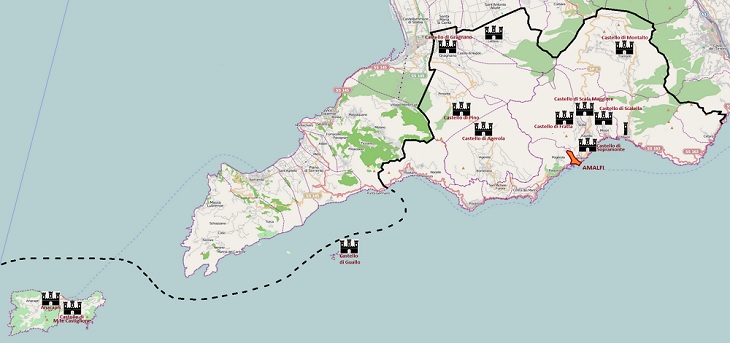
Photo 1. Repubblic of Amalfi
In the mills and the Valley hosting them, the historical origins of the current productive system can be traced, which makes Gragnano today, the “city of pasta”, while in the past it also produced cloth and silk.
In fact, the Valley of the MIlls in Gragnano, according to an Israelian film crew, who have been several times to the site as it was suitable for film shooting, concludes the parallel processing path of pasta and silk that, according to current thinking, was born in the Far East with the Chinese; according to another in the Middle East with the Arabs. According to a third hypothesis, however, it is connected to the working techniques originated in China, imported to Arab countries and then introduced to the West through the inhabitants of Amalfi. Morphology with the climate, the distribution of the urban fabric and the production and costruction techniques with their primitive grinding systems. Therefore, it deserves more valuation, because it admirably combines the past, present and future.
The Valle dei Mulini is also a green area within walking distance of the city. Along its path, which follows the ancient route connecting Stabia to Amalfi, originally perhaps a Roman path, then a Franco-lombard one, then Amalfitan and finally Angevin, you enter into a ravine of lush vegetation, sometimes wild sometimes Mediterranean scrub, into which flow the streams of the surrounding mountains.
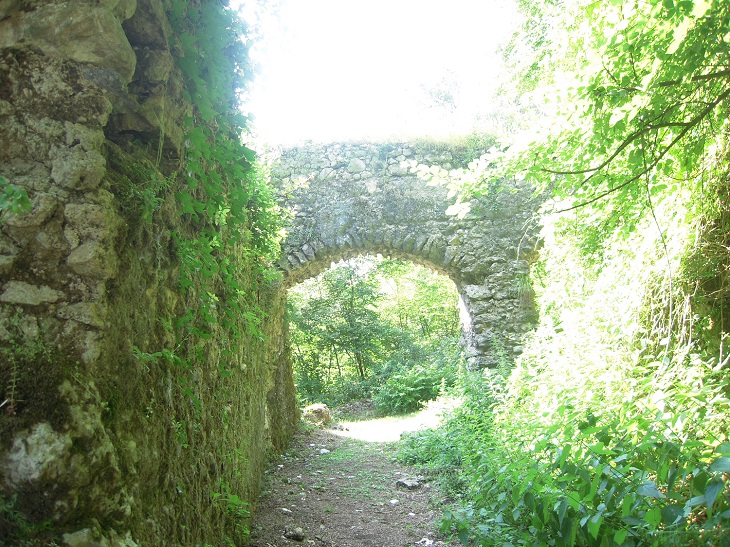
Photo 2. Path
At the foot of the Monti Lattari (Mount Megano, Pine hill and mountain of Agerola), with the presence of the medieval village of Castello, the Torre dei Massi and other sites cannot be seen because they are perched in a strategic position, the road one moment winding one moment straight, sometimes uphill, running along the Vernotico creek, in the silence of nature interrupted only by the rare passing of a vehicle or the subdued roar of small waterfells, finally opening out with a surprising view of the majestic Mount Faito.
Historical notes and type of Mills of Gragnano
The mills are the material evidence and the historical memory of the productivity of Gragnano, through the signs of their installation and their use until the introduction of the tax on flour and first steam energy and electricity that then decreed thet the’abandonment. The tax on flour, which was introduced after the unification of Italy by the Piedmontese, penalize small mills, especially in the South, because they were paid according to the turns of the millstone.
The southern and especially the “Valle dei Mulini”, being small in size, reconded a large number of turns, detected by a counter placed on the mill, which inevitably determined the increase of the tax. Subsequently, the introduction of elettricity caused the dislocation of factories in the town center; many pasta factories, in fact, were equipped with the mill. Despite the shift from hydraulic to electric, which had decreed the abandonment, some of them were re-used due to the suspension of electricity during the Second World War.
The history of mills, from birth, is made of steps and mutationsbetween different cultures and different parts of the world. The grain mills were probably conceived in the Middle East and were introduced in the Roman Imperial era. Plinio il Vecchio, in fact, for the period up to 75 d.C. speaks of their wide diffusion in Italy. The first roman water mill was a horizontal wheel mil, with a vertical shaft transmitting motion to the grind placed over a fixed one, typology existing in the “Valle dei Mulini”.
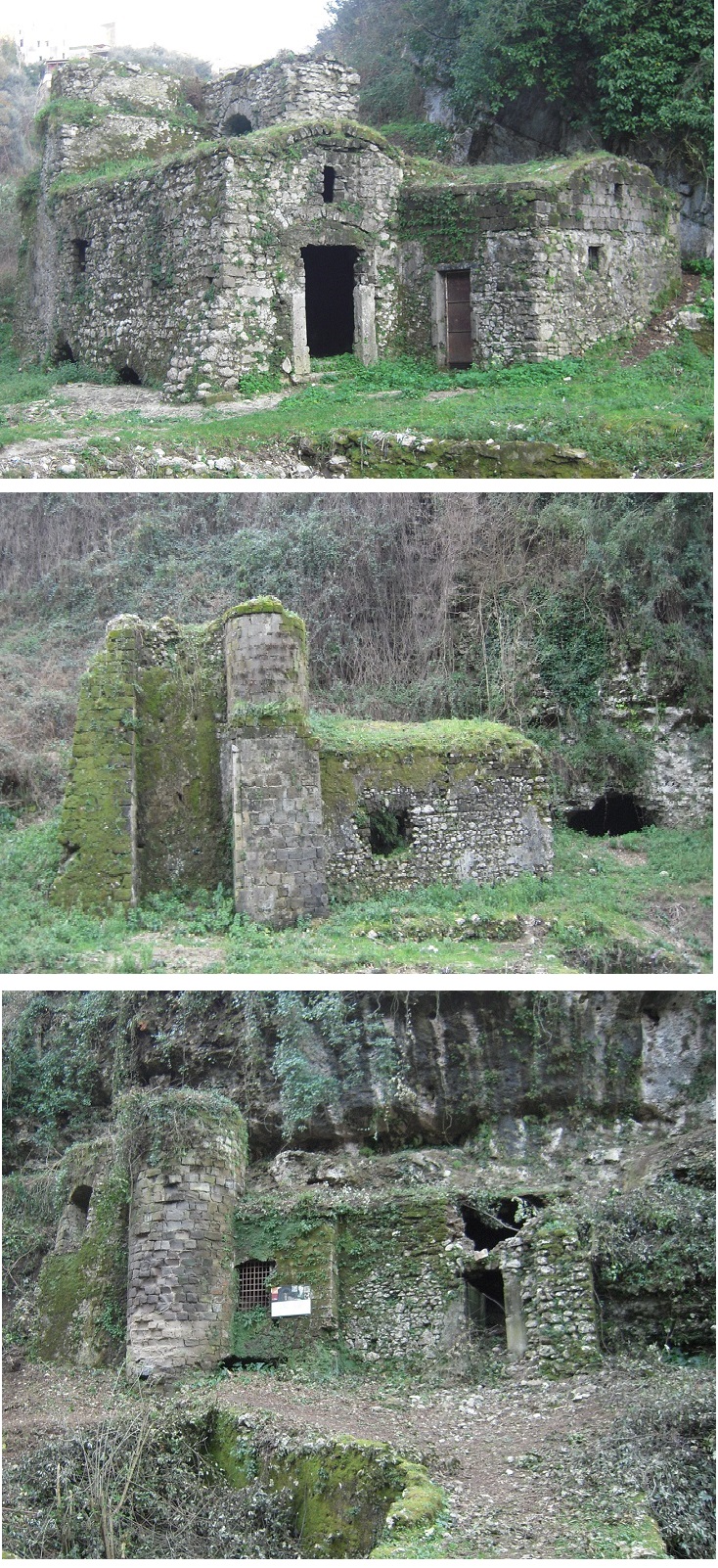
Photo 3. Prospects of some gragnano’s mills
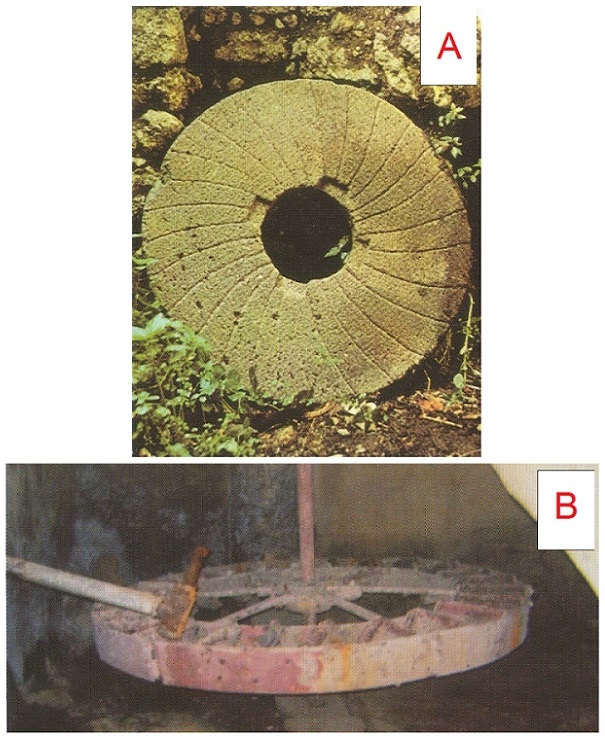
Photo 4. A_ Example of a millstone Fixed with grooves to allow the escape of the ground B_ Example waterwheel underground iron
Objectives Operation of the Mills horizontal wheel
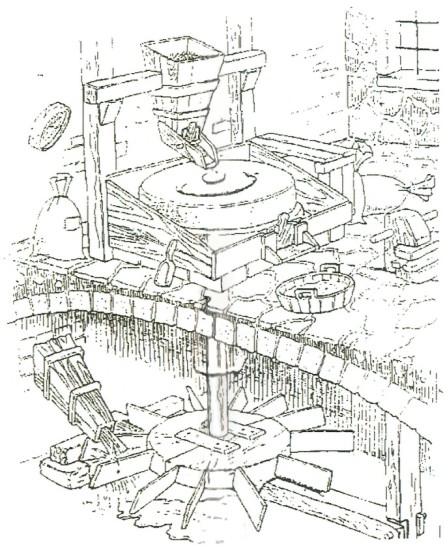
Through a vertical axis, the drive wheel in wood was made integral with the two millstones, one fixed at the bottom with grooves and the upper movable lighter. It was usually used the molar stone quarries of San Giuliano in Molise because it consist of a limestone matrix with fragments of quartz which gave the dual characteristic of hardness and workability for the joints needed for the positioning and the grooves thet enable the ground wheat, fluor or semolina, scroll to the outside for collection.
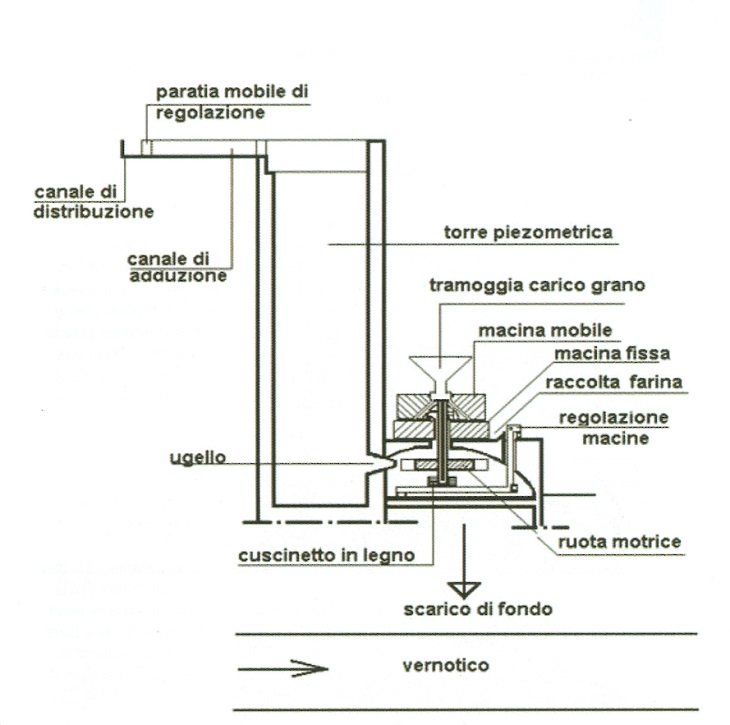
Photo 5. Operating diagram
To avoid the wear due to friction at the base of the axis fixed to the drive wheel and the movable grindig, they used harwood and lubricates with the fat end of the shaft and the bearing on which the rotated axis. A system of levers operable from the outside allow small displacements of the movable grindig to prevent or decrease the friction between the latter and the fixed one.
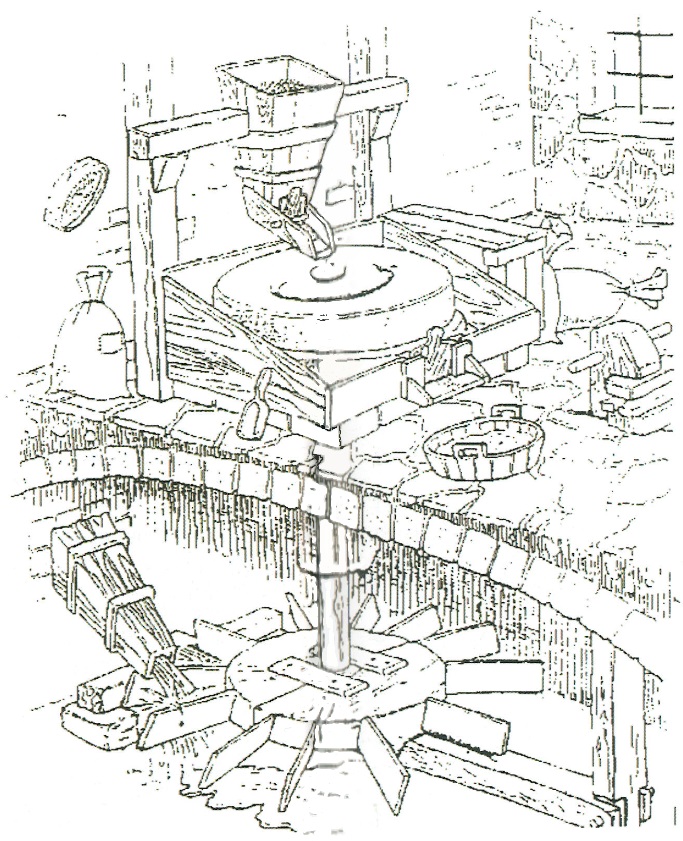
Photo 6. Operating diagram – Isometric View
On top of the movable grinding and coaxial therewith was fixed a loading hopper where you entered the grist through side channels that flowed into the gap between the grindstone mobile and fixed. Grooves in the shape of rays, made by skilled artisans, direct the flour or semolina outwards.