
TeSSPACS Project “Tendon System for Earthquake Protection of Historical Structures made of Stone Blocks”
Tendon system have successfully been applied to historical structures for earthquake protection in several occasions, being probably the earliest case the Collegiate of San Michele in Solofra, Italy in 1986. In this church non pre-stressed steel bars were inserted into the structure in the horizontal and vertical directions without presumably interaction with the masonry. The forces in the tendons that develop during the earthquake have a stabilizing effect on the structure. In a similar fashion, steel bars with shape memory alloy devices (SMA device) were installed in the four corners of the bell tower of the San Giorgio in Trignano church during the ISTECH project. The SMA devices control the forces in the tendons in a passive manner and also limit them.
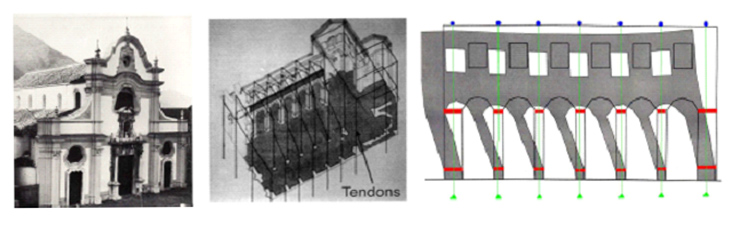
Early example of a tendon system in the Collegiate of San Michele in Solofra, Italy
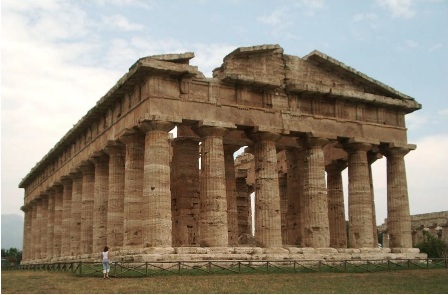
Tendon systems are based on controlled motion of rigid body mechanism. Through them, the kinetic and potential energy of the system is kept small, resulting in small displacements and forces. The concept is especially attractive for historical structures because their installation requires minimal intervention and can be easily removed without causing external visual impact, both a request in some major sites when retrofitting historical structures like in the case of the reference building in this project: the Temple of Neptune in Paestum, Italy. As with all Greek temples, it is an assembly of rigid bodies (stone blocks and columns drums). Therefore these ruins are best suited for the application of a tendon system for earthquake protection.
The Temple of Neptune in Paestum, Italy
In this project, Substructure or Hybrid Simulation plays an important role as it can validate the numerical modeling of complex and large non-linear structures with comparatively little effort. In this kind of simulation, a numerical model is coupled online with an experimental specimen. The deformations of the numerical model are transferred to the specimen (a substructure), and then the resulting restoring forces are fed back to the numerical model. Substructure tests have at its core a time integration process and in this case, the Subfeed algorithm is going to be applied. This method presents the advantage in this project that the experimental column can be placed in several key points of the temple (corner column, center column, etc.) in an effective way by changing its virtual position in the numerical model, observe how close to reality behavior is and finally make the necessary numerical adjustments in order to obtain a more refined model.
Objectives
The objective of the project is the development of a safe numerical modeling for historical monuments made of large stone blocks (like a Greek temple) under earthquake with and without Tendon Systems.
The following objectives will be pursued:
- Development of a mechanical model for the behavior of the joints between large stone blocks under cyclic loading. Through experimental work, a detailed local Finite element model will be created. Then, with the help of mechanically consistent scaling, constitutive macro-element laws that will couple the global degrees of freedom with the local FE model will be developed. Therefore a fast, mechanically realistic simulation under earthquakes at the system level is possible without loosing information at the local level since there is nothing that forbids scaling back to the micro-element at any time.
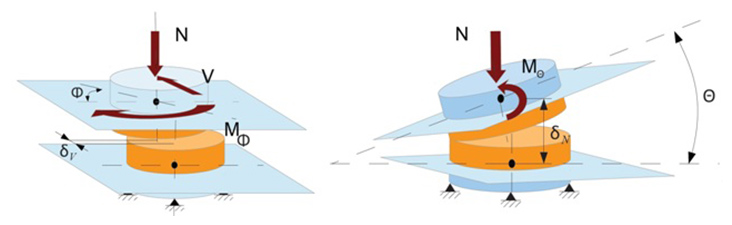
Mechanical model of the joints between stones
- Identification of a linear dynamic model for such structures considering the soil conditions using the Temple of Neptune in Paestum as an example. This will provide the mechanical input data for the hybrid simulation tests including the soil. As a side effect, possible previous remnants of buildings and miscellaneous objects can be identified that may have some archeological interest.
- Development and validation of the non-linear model through the use of hybrid simulation. A complex structure ( a stone column composed of several blocks that later will incorporate a tendon) will be used as a specimen in the laboratory and it will be coupled on-line with the numerical model. This numerical model will represent the complete structure, the Temple of Neptune in Paestum in this case. By “changing” the position of the experimental column within the numerical model (as a corner column and afterwards as a side column for example) the precision and exactitude of the numerical model can be analyzed.
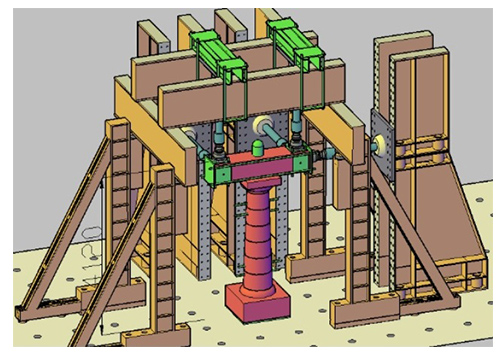
1:3 Scale column as an experimental substructure
REFERENCES
- E. Tortorella, I. Marino, M.N. Khanlou, U. Dorka, L. Petti “Seismic response control of rigid block systems by using tendon system: The case of greek columns”, WCCE – ECCE – TCCE Joint Conference: Seismic Protection of Cultural Heritage, 31st October – 1st November 2011, Calista Luxury Resort, Antalya, Turkey
- Stefano De Luca (Direttore editoria) (1987) “Restauri a Solofra la Collegiata di San Michele“. De Luca Editore s.r.l. Roma.
- Castellano, M. G., Indirli, M., Martelli, A., Azevedo, J. J., Sincraian, G. E., Tirelli, D., Renda, V., Croci, G., Biritognolo, M., Bonci, A., Viskovic, A. (1999) “Seismic protection of cultural heritage using shape memory alloy devices – An EC funded project (ISTECH)”. Proc. International Post-SMiRT Conference Seminar on Seismic Isolation, Passive Energy Dissipation and Active Control of Vibrations of Structures Vol. 1, 417-443, Cheju, Korea.
- Bayer, V., Dorka, U.E., Füllekrug, U, Gschwilm, J. (2005) “On real-time pseudo dynamic sub-structure testing: algorithm, numerical and experimental results“, Aerospace Science and Technology Vol. 9, 223- 232.
- Dorka, U. E., Queval, J. C., Nguyen V. T. and Maoult, A. L. (2006) “Real-time sub-structure testing on distributed shaking tables in CEA Saclay“. Proc. 4th World Conference on Structural Control and Monitoring Paper No. 084, San Diego, USA.
- Nguyen, V. T., Dorka, U. E. (2008) “Phase lag compensation in substructure testing based on online system identification“, Proc.14th World Conference on Earthquake Engineering Paper No. 12-01-0148, Beijing, China.
- Obón Santacana, F., Dorka, U.E. (2011) “Use of large numerical models and high performance computers in geographically distributed seismic tests“, in Fardis M., Rakicevic, Z. (Eds.), Role of Research Infrastructures in Performance-based Earthquake Engineering, 199-219, Springer.
- Obón Santacana, F., Dorka, U.E. (2012) “Effects of large numerical models in continuous hybrid simulation” Proc.15th World Conference on Earthquake Engineering Paper No. 1921, Lisbon, Portugal.
- Dorka, U.E. (2012), “Mechanically consistent scaling of composite beam-column joints”, Advances in Structural Engineering Vol. 15 No. 9, 1609-1618