
Modelling and analysis of base isolated structures with friction pendulum system considering near fault events
Friction Pendulum System Principles
The FPBs consists of a spherical sliding surface and an articulated slider which is faced with a high pressure capacity bearing material. The bearing, which realize a pendulum system, may be installed also upside-down with the spherical surface facing down rather than up. In both installation methods the behavior is identical. A cross section view of an FPBs is shown in following.
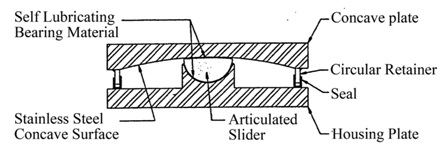
Friction Pendulum system
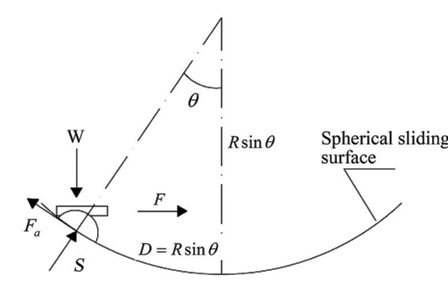
In particular, a friction pendulum system is constituted by a swivel slider that oscillates around the center of curvature of a concave spherical surface whose radius R is equivalent to the pendulum length.
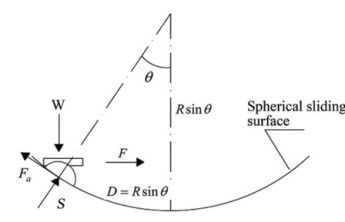
Equilibrium of the pendulum
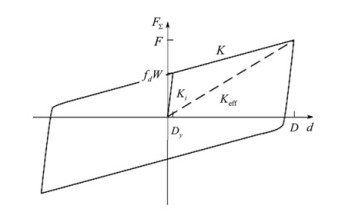
Dynamical characteristics of an FPS
One of the most important properties of FPBs is that the fundamental reference period of vibration of the isolated system is independent of the overall mass and can be evaluated by the pendulum behavior as:

The lateral force provided by an FPBs is directly proportional to the weight it carries and, thus, generally the isolation system force always develops at the center of mass of the supported structure if overturning effects and vertical behavior are neglected. For the single bearing, the friction force is equal to:

which leads, by considering the rotational equilibrium, to the following horizontal restoring force F :

where is the dynamic friction coefficient, D the horizontal displacement, W the vertical load and R the radius of the curvature of the bearing. In the case of little oscillations, small values of the ratio , the relationship between the restoration force and displacement can be write as:

As figure 2 shows, real FPB device presents initial elastic stiffness due to the constitutive material behavior. Instead, the secant stiffness can be evaluated in correspondence of the maximum displacement Dmax as:

Therefore, the effective fundamental vibration period Teff does not coincide with the reference period TR evaluated from pendulum behavior being:

The effective damping provided by a friction isolator is equal to the integer of the hysteresis cycle area:

Main issues
Petti et.al. investigated the Friction Pendulum Bearings effectiveness in reducing seismic response when the vertical component of seismic motion is relevant like the case of near-fault events. The carried out analyses, by varying radius of curvature and friction of FPBs, lead to investigate the effect of the vertical seismic component on the base relative displacement, the base shear and effective fundamental period of vibration.
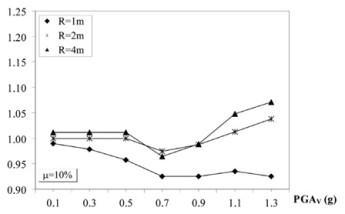
Maximum displacement 3D/2D ratio
Emilia Romagna event
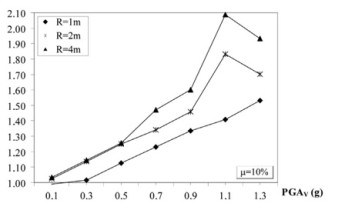
Maximum shear 3D/2D ratio
Emilia Romagna event
The vertical ground motion has a great relevance on the seismic response of structures, especially on the base shear. Instead, the relative displacements substantially are not highly influenced by the vertical ground motion with exception for small radius of curvature.
NORME E BIBLIOGRAFIA
- L. Petti, F. Polichetti, A. Lodato, B. Palazzo (2013). “Modelling and Analysis of Base Isolated Structures with Friction Pendulum System Considering near Fault Events” Open Journal of Civil Engineering (OJCE), Vol. 3, No. 2, June 2013, Scientific Research. DOI: 10.4236/ojce.2013.32009.
- J. L. Almazan, Juan C. De La Llera (2003). “Physical Model for Dynamic Analysis of Structures with FPS Isolators”. Earthquake Engineering Structural Dynamics Volume 32, Issue 8, pages 1157–1184, Department of Structural Engineering, Pontificia Universidad Catolica de Chile, DOI:10.1002/eqe.266
- F. Khoshnoudian and V. Rezai Hagdoust (2009). “Response of Pure-Friction Sliding Structures to Three Components of Earthquake Excitation Considering Variations in the Coefficient of Friction,” Scientia Iranica, Vol. 16, No. 6, 2009, pp. 429-442. ISSN: 1026-3098
- L.-Y. Lu, M.-H. Shih, S.-W. Tzeng, C.-S. Chang Chien (2003). “Experiment of a Sliding Isolated Structure Subjected to Near-Fault Ground Motions”, Proc. 2003 Pacific Conference on Earthquake Engineering, Paper 121, Dept. of Construction Engineering, National Kaohsiung First University of Science and Technology, Kaohsiung, Taiwan, ROC,
- S. Mokha, M. C. Constantinou and A. M. Reinhorn (1993). “Verification of Friction Model of Teflon Bearings under Triaxial Load,” Journal of Structural Engineering, Vol. 119, No. 1, 1993, pp. 240-261, ASCE. ISSN 0733-9445/93/0001-0240
- G. Mosqueda, A. S. Whittaker and G. L. Fenves (2004). “Characterization and Modeling of Friction Pendulum Bearings Subjected to Multiple Components of Excitation,” Journal of Structural Engineering, Vol. 130, No. 3, 2004, pp. 433-442. DOI:10.1061/(ASCE)0733-9445(2004)130:3(433)
- L. Petti, F. Polichetti, B. Palazzo (2013). “Analysis Of Seismic Performance Of Fps Base Isolated Structures Subjected To Near Fault Events ” International Journal of Engineering and Technology” (IJET), Vol. 5, No. 6, December 2013 – January 2014. ISSN : 0975-4024.
- H. Shakib, A. Fuladgar (2003). “Response of Pure-Friction Sliding Structures to Three Components of Earthquake Excitation “, Computers and Structures, N. 1/2003, pp. 189-196, 2003, Elsevier, Department of Civil Engineering, Tarbiat Modarres University, Tehran, Iran 2003. DOI:10.1016/S0045-7949(02)00444-3.
- Victor A. Zayas (1987). “Earthquake Protective Column Support”, United States Patents, Patent Number 4644714, Date of Patent 24 Feb 1987. Alameda, California.